

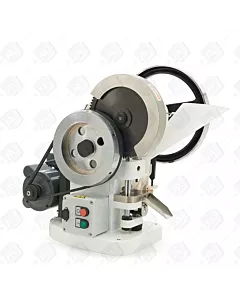
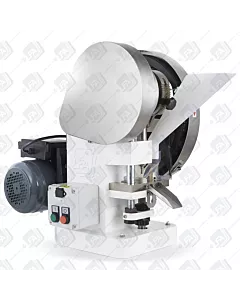

This is a frequently asked question on the TDP range. This range of single station pill press includes the TDP 1.5, TDP 5 and TDP 6s. The machines are very similar and the main distinction between them is the pressure that is exerted during tablet making.
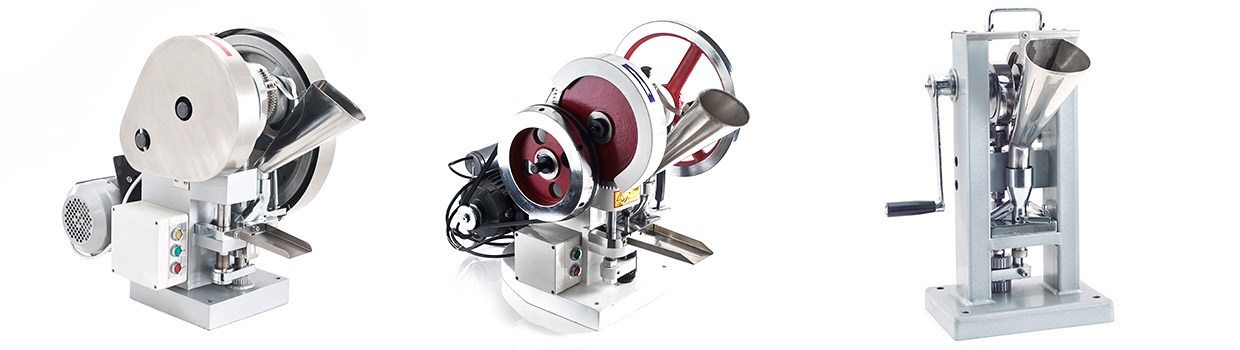
What is a Single Station Tablet Press and How Does It Work?
A single station tablet press is a simple mechanical machine used to compress powder into tablets that are uniform in size, shape, and weight. These machines are designed for low-volume tablet production and are commonly used in R&D, formulation testing, and small batch manufacturing.
What is a Single Station Tablet Press?
A single station tablet press operates using one die and a single set of upper and lower punches. Unlike rotary tablet presses, which use multiple tooling stations, a single station press produces one tablet per compression cycle.
Because only one tablet is formed at a time, these machines offer greater flexibility and control during setup and adjustment. This makes them particularly useful when tablet size, formulation, or compression parameters need to be changed frequently.
Operation of a Single Station Tablet Machine
In a single station tablet press, tablets are produced by compressing powder in a single die using one upper punch and one lower punch. The powder formulation depends on the intended application and may include active ingredients, excipients, lubricants, and disintegrants.
Single station tablet presses may be manually operated or motor driven. Manual presses produce tablets one at a time, while motorized models are capable of small production runs, typically up to 5,000 tablets per hour.
Components of a Single Station Tablet Press
A typical single station tablet press consists of a small number of core mechanical components that work together to form tablets. Because the machine uses only one tooling station, each component plays a direct role in tablet quality and consistency.
Key components include:
- Hopper – holds the granulated material and feeds it into the die by gravity
- Die – forms the tablet shape; the lower punch creates the base of the die cavity
- Upper Punch – applies compression force to bind the powder into a tablet
- Lower Punch – supports the powder during compression and ejects the finished tablet
- Cam Track – guides the vertical movement of the punches
- Capacity Regulator – controls the depth of powder fill in the die
- Ejection Regulator – ensures smooth and consistent tablet ejection
- Driving Wheel – controls punch motion and hopper shoe movement
Together, these components allow the operator to control powder fill, compression force, tablet thickness, and ejection, making the single station tablet press a precise tool for low-volume tablet production.
Tablet Compression Process
A single station tablet press produces tablets through a repeatable sequence of steps that control tablet weight, thickness, and mechanical strength. Because only one tablet is formed per cycle, each stage can be closely monitored and adjusted as needed.
Filling
The upper punch withdraws from the die while the lower punch sits low in the die cavity. Powder flows from the hopper by gravity and fills the space created by the die and lower punch.
Metering
The lower punch rises to the preset fill depth, ejecting excess powder from the die. This step determines the tablet weight.
Compression
The lower punch remains stationary while the upper punch descends into the die, compressing the powder into a tablet.
Ejection
The upper punch withdraws and the lower punch rises, lifting the formed tablet from the die. The tablet is then removed from the die surface and collected.
This cycle is repeated for each tablet produced.
Advantages of a Single Station Tablet Press
Single station tablet presses, also known as single punch presses, offer several advantages for low-volume tablet production where flexibility and control are more important than high output.
Key advantages include:
- Compact and durable design suitable for benchtop use
- Simple mechanical operation and operator-friendly controls
- Adjustable fill depth, tablet thickness, and compression force
- Suitable for a wide range of granular materials and formulations
- Available in manual or motorized configurations
- Lower cost compared to rotary tablet presses
- Ideal for R&D, pilot production, and small batch manufacturing
Because each tablet is produced individually, the operator can closely monitor tablet quality and make precise adjustments during formulation development.
Maintenance and Precautionary Measures
Proper maintenance and careful operation are essential to ensure consistent performance, product quality, and long service life of a single station tablet press.
Before operating the machine, the following precautions and maintenance practices should be observed:
- Read the instruction manual thoroughly before first use
- Lubricate the machine regularly according to the manufacturer’s recommendations
- Apply lubricant only to designated oil points and friction surfaces
- Empty the machine before performing lubrication
- Use the minimum recommended amount of lubricant to avoid product contamination
- Operate the driving wheel only in the specified direction
- Make belt and mechanical adjustments carefully to prevent binding or jarring
- Ensure the upper punch is in its highest position before powering the machine
Regular inspection and fine adjustment help maintain tablet consistency, especially during extended production runs.
Single Punch Machines Available from LFA Machines
LFA offers a range of reliable single station tablet presses designed for R&D, pilot production, and low-volume manufacturing. Each model provides precise control over tablet size, weight, and compression force to support consistent tablet quality.
TDP 0 Desktop Single Punch Tablet Press
- Compact, manual benchtop unit
- Ideal for small batches, testing, and formulation development
TDP 1.5 Desktop Single Punch Tablet Press
- Manual desktop unit with motorized assist
- Adjustable tablet thickness, punch pressure, and fill depth
- One punch and die set included
TDP 5 Desktop Single Punch Tablet Press
- Most popular model in the LFA range
- Produces tablets up to 20 mm in diameter
- Heavy-duty desktop design for consistent operation
TDP 6s Desktop Single Punch Tablet Press
- Highest compression force in the range
- Produces tabelts up to 25 mm in diameter
- Precision filling with low material waste
Find the Right Single Station Tablet Press
LFA offers a range of single station tablet presses designed for R&D, pilot production, and low-volume manufacturing.
Ready to find the perfect single punch tablet press for your application?
Contact our sales team or browse our full range of single station tablet presses to get started.


